1. Overview
The UAE has positioned itself as a global business hub, welcoming entrepreneurs from every corner of the world. Since landmark reforms in 2021, foreigners can own 100% of their UAE business in most sectors, eliminating the previous requirement for a UAE national partner. This guide provides a comprehensive overview of company formation options, processes, and requirements for international investors.
2. Key Advantages for Foreign Investors
- 100% foreign ownership permitted in most mainland sectors (since 2021 amendments to Commercial Companies Law)
- Full repatriation of profits and capital — no restrictions on fund transfers
- No personal income tax for individuals
- Corporate tax of only 9% (applicable from June 2023, exempt for free zones meeting conditions)
- VAT at 5% — among the lowest in the world
- Strategic location connecting East and West — within 8 hours flight of 2/3 of the world’s population
- World-class infrastructure: ports, airports, roads, and digital connectivity
- Political stability and safety — consistently ranked among safest countries
- Over 40 free zones catering to specific industries
3. Types of Business Entities
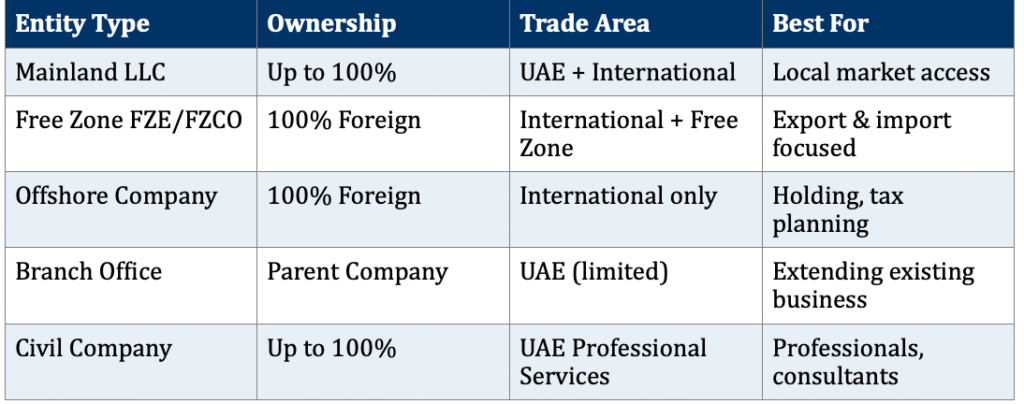
4. Sectors Open to 100% Foreign Ownership
Following the 2021 Commercial Companies Law reforms, the following sectors permit full foreign ownership on mainland:
- Manufacturing and industrial operations
- Information technology and software development
- Renewable energy and environmental services
- Agriculture and food processing
- Hospitality and tourism
- Healthcare and pharmaceuticals (with regulatory approvals)
- Education and training
- Transportation and logistics
- Retail and e-commerce
- Consulting and professional services
5. The Company Formation Process
1. Define Business Activity: The UAE classifies activities as commercial, professional, industrial, or tourism-related. Your activity determines your licence type.
2. Choose the Right Jurisdiction: Mainland vs. Free Zone vs. Offshore — each has different implications for where you can trade and how you are taxed.
3. Select Company Structure: Decide on LLC, FZE (single owner), FZCO (multiple owners), or branch. FZE requires minimum 1 shareholder; FZCO requires 2–50.
4. Reserve Trade Name: File a trade name reservation. The name must not contain offensive words, names of ruling families, or religious references.
5. Initial Approval: Obtain initial approval from DED or the relevant free zone authority. This confirms the activity is permissible.
6. Draft & Notarise MOA: Prepare the Memorandum of Association, detailing ownership structure, activities, and capital. Notarize at a UAE court or notary.
7. Lease Business Premises: Sign a tenancy agreement and register with Ejari (Dubai) or equivalent system. Flexi-desks are accepted in many free zones.
8. Obtain Trade Licence: Submit all documents, pay fees, and receive the trade licence. This is your primary operating permit.
9. Corporate Bank Account: Open a business bank account. Due diligence requirements are strict — be prepared with full corporate documents.
10. Visa Processing: Apply for investor visa, residence visa, and Emirates ID. Process takes 2–4 weeks typically.
6. Free Zone Options by Industry
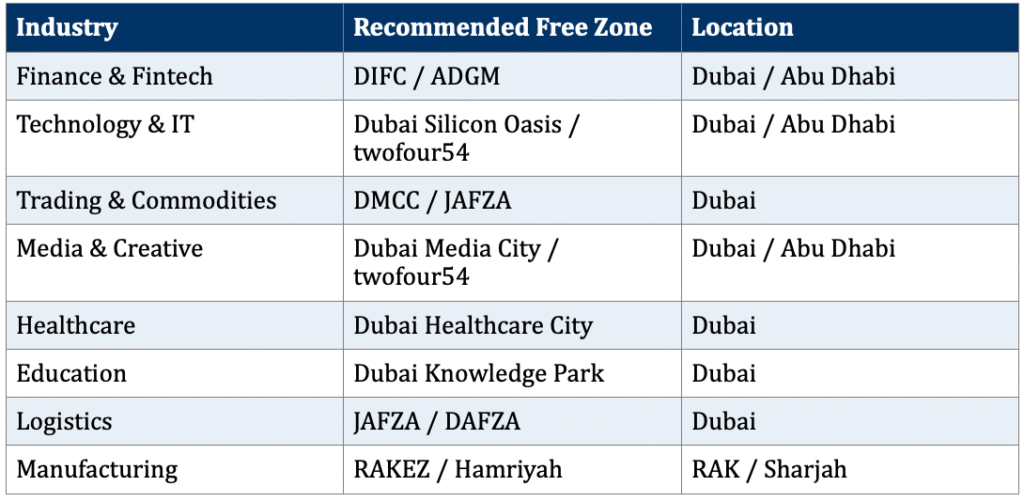
7. Document Requirements for Foreign Nationals
- Valid passport (all shareholders and managers)
- Proof of residence in home country
- Passport-size photographs
- Business plan
- Bank reference letter or personal bank statements
- Source of funds declaration (for certain activities)
- Educational certificates (for professional licences)
- No Objection Certificate if employed elsewhere
- Corporate documents (if parent company is a shareholder) — attested and translated
8. Cost Ranges by Jurisdiction (2025)
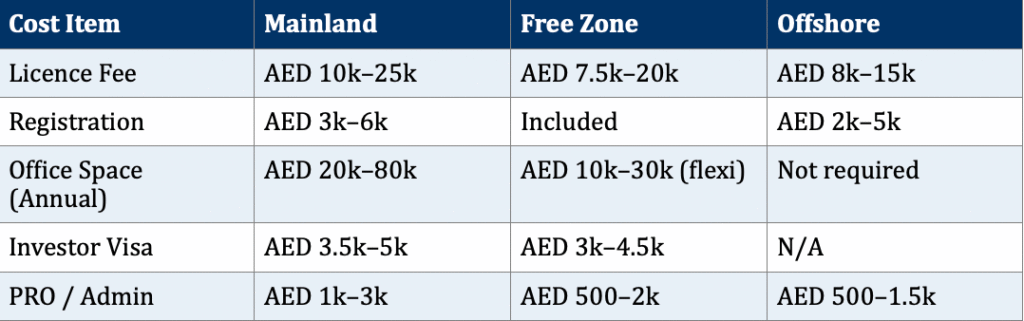
9. Tax Framework for Foreigners
Understanding the UAE tax framework is critical for foreign business owners:
- Corporate Tax: 9% on taxable profits exceeding AED 375,000 (Small Business Relief available for revenues under AED 3 million)
- Free Zone Entities: May qualify for 0% corporate tax if meeting Qualifying Free Zone Person (QFZP) criteria
- VAT: 5% standard rate on most goods and services; some healthcare and education are zero-rated
- Excise Tax: 100% on tobacco and energy drinks; 50% on carbonated beverages
- No capital gains tax, inheritance tax, or wealth tax
- Double Tax Treaty (DTT) network: UAE has 130+ DTTs, useful for international tax planning
10. Conclusion
The UAE offers one of the world’s most accessible and rewarding environments for foreign company formation. From full foreign ownership rights to a low-tax regime and world-class infrastructure, the country continues to attract global entrepreneurs. With proper planning, the right jurisdiction choice, and professional support, foreign nationals can establish a robust, compliant, and profitable business presence in the UAE.